ANALYSIS: Revisiting Iran’s 9/11 connection
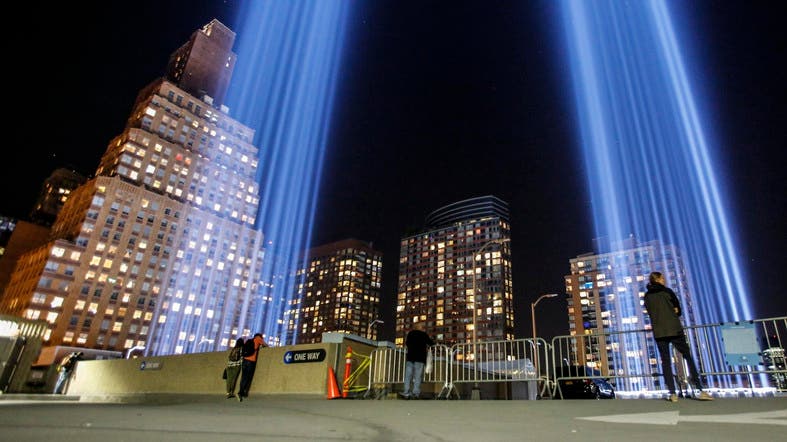
People gather on a rooftop as the ‘Tribute in Light’ illuminates the night sky, on September 10, 2017 in New York. (AFP)
16 years have passed since that tragic day, September 11, 2001, when over 3,000 innocent people lost their lives in the “the largest mass casualty terrorist attack in US history.” The course of modern history changed as we know it.
For more than 15 of these past years the policy of appeasement has withheld the international community from adopting the will needed to bring all the perpetrators of this hideous crime to justice.
Iran has a history of fueling foreign crises to avoid responding to its own domestic concerns. 9/11 provided the window of opportunity to derail world attention to other states and buy Tehran crucially needed time.
Unfortunately, the regime ruling Iran has been the main benefactor of the 9/11 aftermath. As a result of two wars in the Middle East the entire region has been left wide open for Tehran to take advantage of and spread its sinister ideology and sectarianism.
It is hence necessary to highlight Iran’s role in 9/11 attacks and demand the senior Iranian regime hierarchy involved in blueprinting and implementing this attack to be held accountable before the law.
Warmongering history
For the past four decades Iran has been ruled by a clerical regime that is simply incapable of providing the society’s needs and demands. To this end, Tehran has resorted to a policy of exporting the “Islamic Revolution” by meddling in neighboring and distant countries to create havoc.
History has recorded how Iraq invaded Iranian territories and caused the beginning of the devastating eight-year-long Iran-Iraq War. Several months before Iraq launched its military attack, Ayatollah Khomeini, accused of hijacking Iran’s 1979 revolution, described then Iraqi leader Saddam Hussein as a “hypocrite” and a “threat for the Iraqi people.”
Khomeini went as far as calling on the Iraqi people to “place their entire efforts behind destroying this dangerous individual” and the Iraqi army to “flee their forts” and to “rise and destroy this corrupt individual, and appoint another individual in his place. We will support you in this regard.”
Fast forward more than two decades, and again with Iraq in its crosshairs, Iran began what has been described as a very complicated effort to literally deceive the US intelligence community.
Ahmad Challabi, dubbed as “The Manipulator” by The New Yorker, was Iran’s front man in feeding the US false information regarding Iraq possessing weapons of mass destruction to justify Washington’s 2003 invasion of Iraq. The war ultimately eliminated the main obstacle before Iran’s hidden occupation of Iraq and full blown meddling across the Middle East.
Looking further west in the region, Iran ordered Bashar Assad in Syria and former Iraqi prime minister Nouri al-Maliki to facilitate the escape of thousands of al-Qaeda prisoners. This development, parallel to the ruthless crackdown of the two countries’ Sunni communities, led to the rise of ISIS.
This entire episode provided Iran the necessary pretext to justify its presence in Iraq and Syria, especially through tens of thousands of proxy forces.
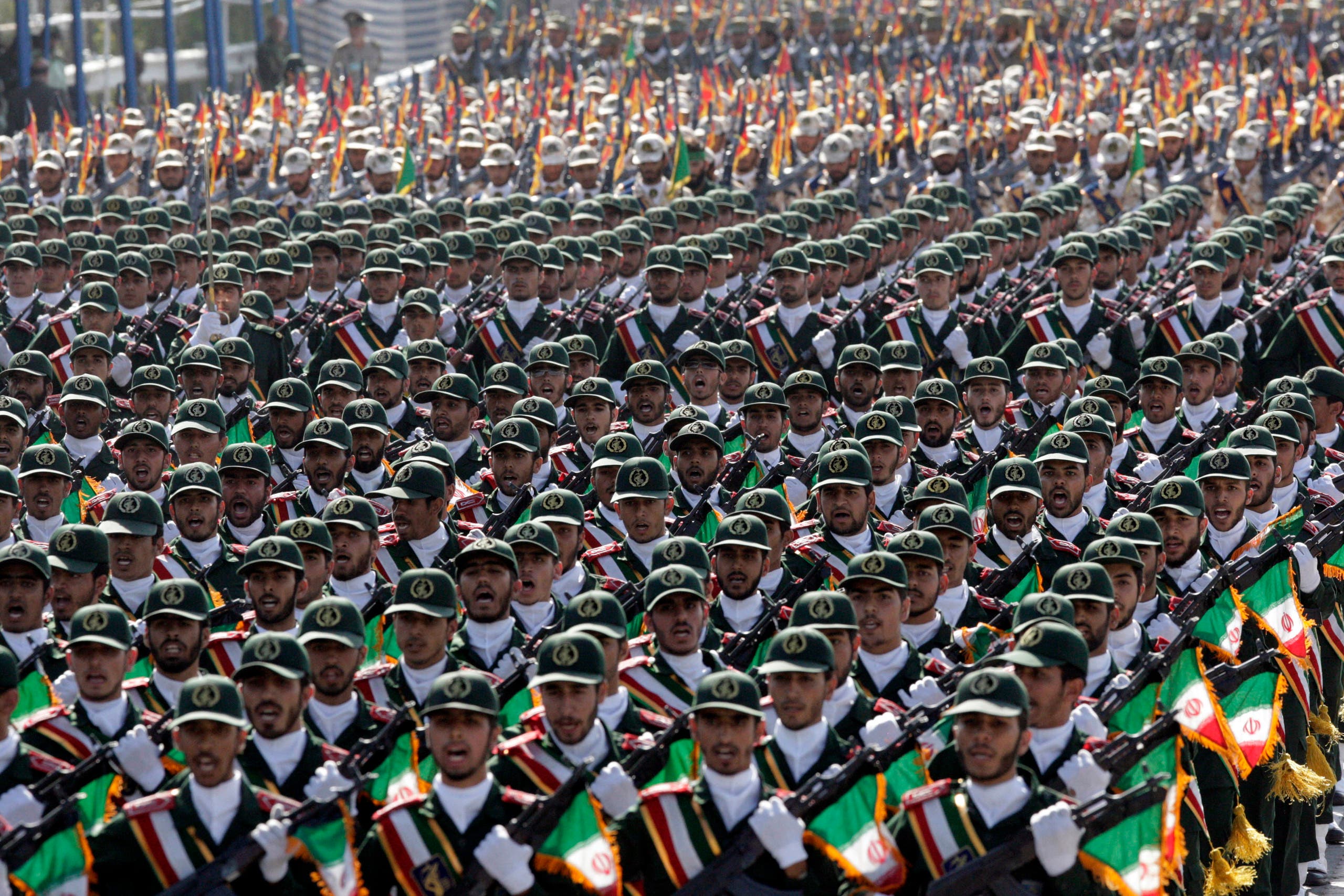
Iran’s Revolutionary Guard troops march, during a military parade commemorating the start of the Iraq-Iran war 32 years ago, in front of the mausoleum of the late revolutionary leader Ayatollah Khomeini, just outside Tehran, Iran, on Sept. 21, 2012. (AP)
The 9/11 facts
A bipartisan commission in Washington investigated the 9/11 attacks reported strong evidence exists showing Iran “facilitated the transit of al-Qaeda members into and out of Afghanistan before 9/11, and that some of these were future 9/11 hijackers.”
Up to 10 of the 14 hijackers involved in 9/11, and specifically behind obtaining control of the four aircrafts, were allowed passage through Iran from October 2000 to February 2001. Reports indicate Iran has a history of ordering certain instructions to not harass transiting al-Qaeda members.
Such documents also show Iran’s offspring, the Lebanese Hezbollah, trained alongside al-Qaeda members during the 1990s, leading to the former possibly adopting the latter’s suicide bombing tactics.
“…al-Qaeda may have collaborated with Hezbollah and its Iranian sponsors in the 1996 bombing of the Khobar Towers, a key American military barracks in Saudi Arabia. Previously, the attack had been attributed only to Hezbollah, with Iranian support,” according to a TIME report.
Evidence shows that five years later, “Iran and Lebanese Shiite group Hezbollah being involved ‘firsthand’ in the 9/11 terrorist attacks,” an Al Arabiya feature said.
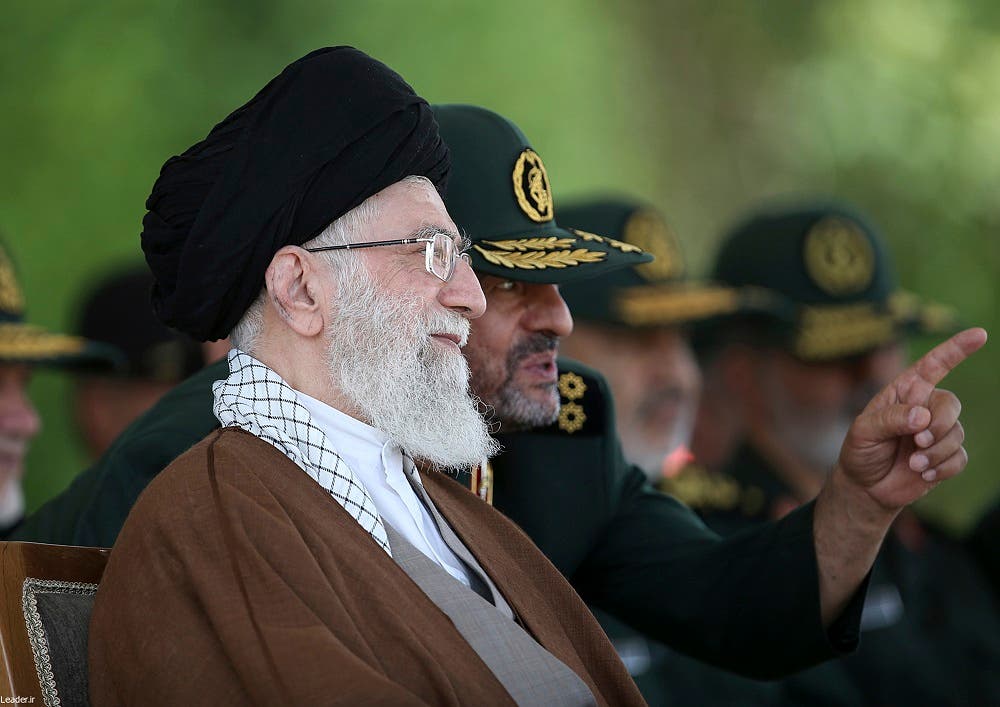
Supreme Leader Ayatollah Ali Khamenei with Revolutionary Guard commander Mohammad Ali Jafari on May 20, 2015. (Office of the Iranian Supreme Leader via AP, File)
Facilitation and execution
In early 2016, Judge George Daniels of New York “condemned Iran for facilitating the execution of the terrorist attacks that hit both New York and Washington.” This lawsuit provided an in-depth look into nearly 300 cases of Iran’s involvement in funding terrorism and collaborating with terror organizations, including al-Qaeda.
“The trial revealed that bin Laden, current leader of al-Qaeda Ayman al-Zawahiri, Hezbollah’s Imad Mughniyeh – assassinated in 2008 – and other Iranian attaches had met in Sudan to establish an alliance supporting terrorism,” the piece adds.
To those who may argue Shiite Iran would never support a Sunni al-Qaeda, it is hardly unprecedented to find such backing by Tehran for non-Shiite terror groups. Sunni terrorists that share Iran’s goals, such as Hamas and Islamic Jihad, alongside those who target US interests, have for long enjoyed Iran’s support.
As mentioned above, “Iran also played an important role in supporting al-Qaeda in Iraq, the progenitor of ISIS. As Michael Weiss and Hassan Hassan noted in their 2015 book ‘ISIS: Insider the Army of Terror,’ AQI head Abu Musab al-Zarqawi was ‘based in Iran and northern Iraq’ for ‘about a year’ after fleeing Afghanistan following the arrival of US-led coalition forces in Operation Enduring Freedom,” according to The Washington Times.
As cited earlier, Iran also stands accused of having “foreknowledge of the 9/11 attacks,” according to a 2011 court filing quoting two Iranian intelligence service defectors. These individuals were “in positions that gave them access to sensitive information regarding Iran’s state sponsorship of terrorism,” the piece continues.


No comments:
Post a Comment